

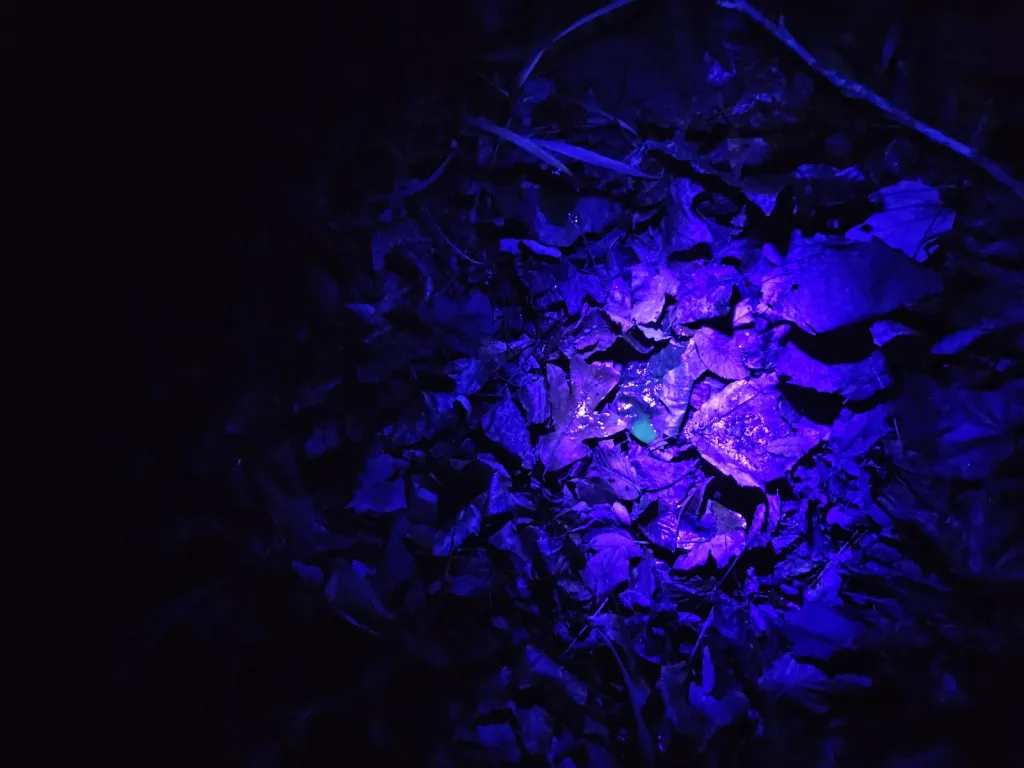
I’ve spent enough nights in the woods to know that blood trailing after a shot isn’t always easy. Sometimes the trail is obvious, sometimes it vanishes after twenty yards, and that’s when frustration sets in. A few years ago a buddy pulled out a cheap UV flashlight, swept it over the leaves, and suddenly we had glowing pink drops lighting up like neon signs. I was hooked. In 2025, UV blood tracking is no longer a “nice-to-have” trick—it’s a standard tool for serious hunters who want to recover game ethically and efficiently. This guide breaks down the real science, how to use UV Light properly, what gear actually works, and the limitations you need to know before you head out.
How UV Light Reveals Blood (The Real Science)
Blood contains porphyrins—organic compounds with a metal core (usually iron)—that fluoresce bright pink to orange-red under ultraviolet light in the 365–395 nm range. When UV photons hit these molecules, they absorb the energy, get excited, then release it as visible light at a longer wavelength (Stokes shift). That’s why fresh blood often glows vivid pink, while older, oxidized blood shifts toward orange-brown. The effect is strongest on porous surfaces like leaves, dirt, grass, and bark, but weakens on non-porous rocks or very wet ground where the fluid soaks in too deep.
This isn’t magic; it’s basic fluorescence spectroscopy. Hunters exploit the same principle forensic teams use at crime scenes, just at a much lower budget.
Why Blood Glows Under UV (Fluorescence Explained)
Hemoglobin in blood breaks down into porphyrin rings after exposure to air and moisture. These rings are fluorescent under near-UV (long-wave UV-A, 365–395 nm). The glow is strongest in fresh to semi-dry blood (first 24–48 hours) and fades as porphyrins degrade further or get washed away by rain/dew. I’ve seen trails that were invisible in daylight but lit up like Christmas lights under a good 365 nm light—even after 36 hours in damp conditions. The color can vary slightly by animal species and diet, but it’s almost always in the pink-orange spectrum.
Best UV Wavelengths for Blood Tracking
Not all UV lights are equal. For blood trailing, you want 365 nm long-wave UV-A (not 395 nm or higher).
- 365 nm: Brightest, most vivid pink glow, penetrates surface moisture better.
- 395 nm: Cheaper “black lights,” but the glow is noticeably weaker and more purple.
- 254 nm (short-wave): Dangerous to skin/eyes, not practical for field use.
I’ve tested dozens of flashlights; anything under 10W at 365 nm is usually too weak for real trails. Look for lights labeled “365 nm UV-A” with at least 5–10 watts output and a tight beam (10–30° for distance).
Gear You Actually Need (Flashlights, Filters & More)
Here’s the realistic minimum kit I carry:
- Primary light: Convoy S2+ with 365 nm LED (or Sofirn SF16, ~$30–50) – bright, durable, affordable
- Backup: Small 365 nm pen light (for close-up inspection, ~$15)
- Yellow/orange filter glasses: Blocks the blue-purple UV spill so your eyes see only the fluorescence (essential at night – $10–20)
- Spare batteries: 18650s or AAAs; cold weather kills battery life fast
- Red headlamp: Preserves night vision while walking to the shot site
Total realistic cost for a solid setup: $60–120. Skip the $200 “blood-tracking” branded lights; they’re usually overpriced rebranded Convoy clones.
Step-by-Step: How to Track Blood with UV Light in the Field
- Wait 20–30 minutes after the shot (gives blood time to oxidize and fluoresce better)
- Get to the last known blood with a red headlamp only (preserves night vision)
- Put on yellow/orange filter glasses
- Sweep the 365 nm light slowly in wide arcs, starting from the hit site
- Mark every glowing drop with flagging tape or biodegradable spray (never use regular spray paint)
- Move slowly—UV trails can skip 5–10 yards on dry leaves
- If trail ends, grid-search 360° from last drop
- When in doubt, go back to last confirmed blood and re-sweep
I’ve recovered deer that dropped less than 10 ml of visible blood because the UV showed faint pink smears on leaves nobody would have seen otherwise.
Common Mistakes Hunters Make with UV Lights
- Using 395 nm instead of 365 nm (glow is weak and purple)
- Sweeping too fast (miss faint trails)
- Not wearing filter glasses (UV spill blinds you)
- Starting immediately after the shot (glow is weaker in fresh blood)
- Relying on UV alone (always confirm with visible light + nose)
- Forgetting spare batteries (cold kills them fast)
Limitations & When UV Light Won’t Help
UV isn’t magic. It struggles with:
- Heavy rain (washes porphyrins away)
- Very old blood (>3–4 days)
- Extremely dry, dusty ground (porphyrins sink too deep)
- Thick pine needles or heavy leaf litter (blocks light)
I’ve lost trails on bone-dry pine ridges even with a strong 365 nm light. Always combine UV with traditional sign (bent grass, hair, bone fragments) and trust your gut..
Conclusion
UV blood tracking isn’t a gimmick anymore—it’s a legitimate, low-cost tool that has helped me and countless other hunters close the gap between “good hit” and “recovered animal.” A decent 365 nm light, yellow filter glasses, and a little patience can turn invisible trails into glowing paths. In 2025–2026, with deer populations high and hunting pressure intense, recovering game ethically is more important than ever. Grab a good light, practice in your backyard, and you’ll wonder how you ever trailed without one. Happy (and successful) hunting.
